Across the Atlantic
From Queenstown & Liverpool to Ellis Island & Cincinnati
When the doors of America opened, the Gaffneys and Cassidys walked through them. Some left as teenagers, others after years in English cities. Some traveled alone, others coordinated their departures with siblings. What united them all was a choice: to leave the land of their ancestors and build new lives in the industrial heartland of Ohio and beyond. Here are their journeys.
The Pull of America
In the late 19th and early 20th centuries, America represented possibility. The Land War had ravaged rural Ireland. Tenants fought landlords, families watched their holdings shrink, and the promise of industrial wages and land ownership beckoned from across the Atlantic. Cincinnati, in particular, had become a magnet for Irish immigrants from the west. The city's foundries, packing houses, and factories offered steady work; established Irish communities provided lodging, jobs, and pathways to naturalization.
The Gaffneys of Falleens faced a special pressure. The Balfe estate, under which their plots were held, had been encumbered and eventually sold through the Encumbered Estates Court. Land ownership slipped away. Meanwhile, the Cassidys of Charlestown—even the comparatively comfortable National Teacher branch—watched their children marry and move out. Chain migration took hold: one sibling emigrated, established himself, and sent word back. Others followed, often within a matter of years or months.
John Gaffney Jr.: The Pioneer
Born 8 January 1874 in Falleens, Co. Sligo, to John Gaffney (anglicization of Eoin/Eoghan) and Jane Casey. Little is known of his childhood, but sometime around 1889—when he was just fifteen years old—John Jr. left for Cincinnati, Ohio. He may have traveled alone or with siblings. Civil records do not survive for his departure, nor does an immigration manifest.
What we know comes from later naturalization papers and census records. He settled in Cincinnati and worked there for years, eventually marrying and starting a family. Unlike most Irish emigrants who naturalized only when citizenship became necessary (for employment, property ownership, or civic standing), John Jr. seems to have stayed within Irish immigrant networks.
His life in America marks the beginning of the Gaffney line in the United States. Two generations later, his descendants remain in Ohio. He was one of four brothers, all of whom scattered: two disappeared from Irish records entirely, one became a farmer in Leitrim, and John Jr. alone successfully relocated to America and established a lasting lineage there.
The Cassidy Chain Migration
While John Gaffney Jr. emigrated as a boy from the Falleens branch, the Cassidys of Charlestown executed a more visible, documented strategy: chain migration. Patrick Cassidy (b. c.1841) and his wife Bridget Kilgallon lived in Bullaun, Co. Mayo, and between 1876 and 1910 had eleven children. Eventually, five of them emigrated to the United States.
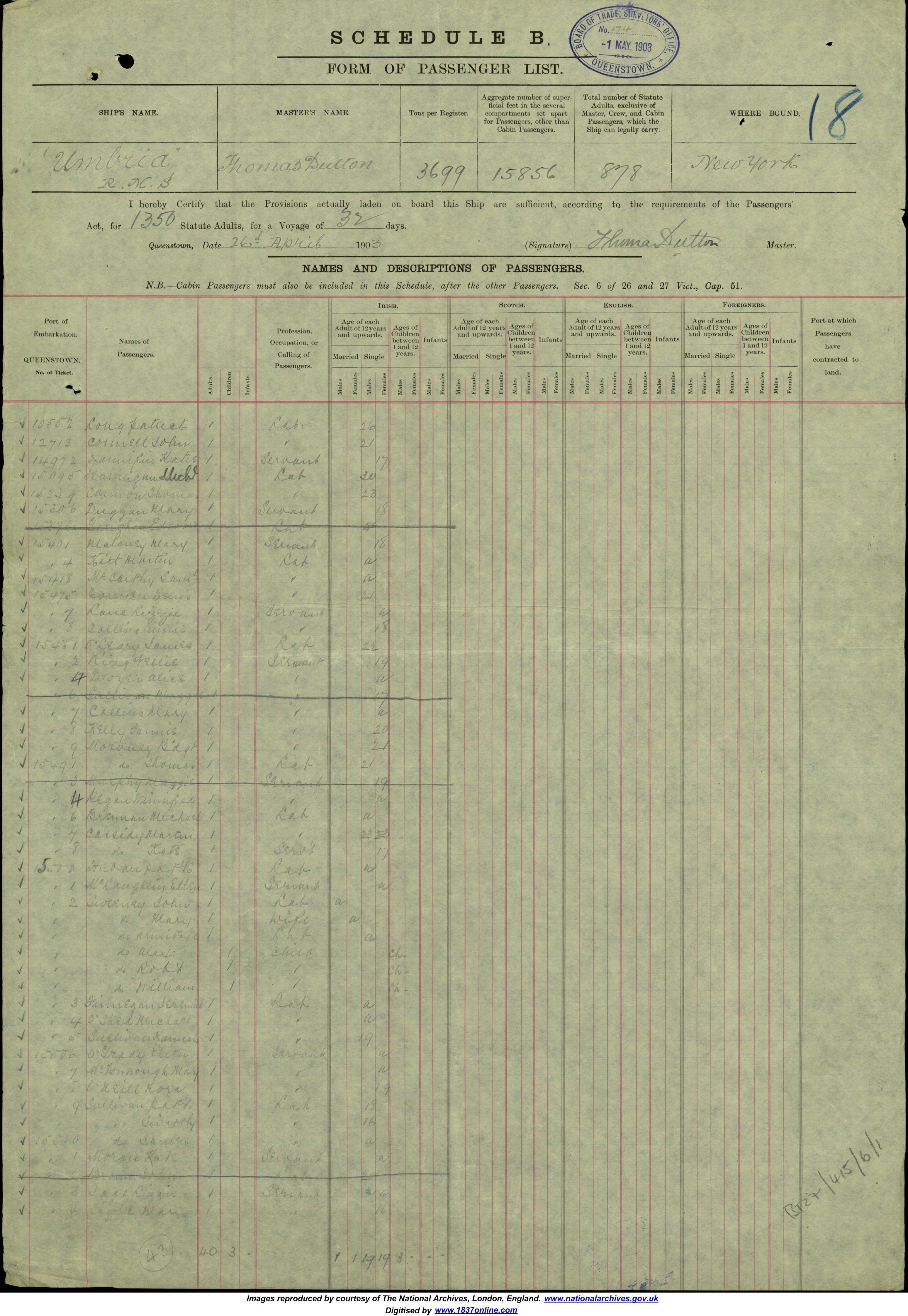
The migration happened in waves. The eldest son, Martin, left first in 1903, taking his seventeen-year-old sister Catherine with him. They arrived in New York on the SS Umbria in late April and settled in Cincinnati. Within a few years, younger brother Peter Francis followed. Another sibling, Catherine, married an Irish-American from Cincinnati whose own parents had emigrated decades earlier. Then came Philip Francis, who took the longest route—first to England, then across the Atlantic. And finally, Margaret Mary (called Peggy), Philip's future wife, made the journey just ten weeks after him.
The pattern reveals itself in the records: each departure was announced by letters home, each arrival led to stable boarding arrangements with established Irish families, and each success prompted the next sibling to follow. It was neither rash nor desperate, but a calculated family strategy to relocate the clan incrementally to a city where relatives and fellow countrymen had already secured footholds.
Martin and Catherine Cassidy: The First Wave
Martin (b. 30 October 1879) and Catherine (b. 6 January 1886)
On 26 April 1903, Martin Cassidy, age 23, and his sister Catherine, age 17, boarded the SS Umbria at Queenstown (now Cobh), Co. Cork, bound for New York. Their parents, Patrick and Bridget, watched them depart from their home in Bullaun. Martin was escorting his younger sister across the ocean—a common arrangement that signaled both family responsibility and intention. The Umbria was a Cunard Line ship, a reputable vessel carrying over 1,000 passengers on a journey that took seven to ten days.

By 1910, Martin and Peter (his younger brother) are both listed as boarders in Cincinnati with the Scanlon family, a fellow Irish household. Martin was working as a laborer, Peter as a clerk. Catherine, meanwhile, married Edward M. Brophy on 27 January 1915 in Hamilton County, Ohio.
The Brophy Connection: County Offaly → Cincinnati
Catherine's husband, Edward M. Brophy (b. c.1885), was the son of James J. Brophy and Rebecca Dolan, who had emigrated from Co. Offaly to Cincinnati in 1863—forty years before Catherine's arrival. Edward was born in Ohio; he was second-generation Irish-American. James J. had established himself sufficiently that his son could marry into the newly arrived Cassidy family without economic barrier. This was not uncommon: the Irish-American community, though internally stratified, often welcomed new arrivals, particularly those who came with family connections already in place.
Catherine's marriage to Edward represents a crucial moment in the Cassidy family's American story. She had left Bullaun as a teenager, crossed the Atlantic in her brother's care, boarded with another Irish family, and within twelve years had married into an established Irish-American household. Her children would be fully American, their parents split between two immigrant generations.
Peter Francis Cassidy: The Quiet Emigrant
Born 6 February 1888 in Carracastle, Co. Mayo, Peter Francis was the sixth child of Patrick and Bridget. Unlike his brother Martin, who left as a young man, Peter emigrated in 1906, when he was eighteen years old. He had spent his childhood in Bullaun, left briefly to serve as a witness at various family baptisms, and then—like his older siblings—took the transatlantic passage.
By 1910, Peter is recorded in the Cincinnati census as a boarder with the Scanlon family—the same household where his brother Martin was staying. He held the occupation "clerk," a modest but respectable position that suggests either education or quick adaptation to American office work.
In 1917, Peter registered for military service in Cincinnati. His WWI Draft Registration Card gives us one of the few detailed descriptions we have of a Cassidy emigrant:
Like many Irish-Americans of his generation, Peter may have considered volunteering for the U.S. Army. Whether he actually served is unclear from available records, but his willingness to register suggests integration into American civic life. Peter lived quietly in Cincinnati, worked in an office, boarded with fellow Irish families, and eventually built a life that—to all appearances—was stable and unremarkable. He is one of dozens of Irish emigrants whose stories end there: they came, they worked, they assimilated. No descendants are known to be actively researching his line.
Philip “Finny” Francis Cassidy: The Circuitous Route
Born 16 March 1900 in Carracastle, Co. Mayo, Philip Francis was the youngest son of John and Annie (née Doherty) Cassidy—a different Cassidy family from Patrick and Bridget's line. (The question of whether the two families were related remains unresolved, though circumstantial evidence suggests a distant connection.) John Cassidy was a National Teacher—a man of some social standing—and Annie was also a teacher. Philip was their youngest child, educated, and comfortable.
Yet comfort in rural Mayo was not enough. Around 1915–1920, as a young man in his late teens or early twenties, Philip emigrated—not directly to America, but to England. Like other Irish emigrants of the period, he crossed the Irish Sea to Birmingham, where Irish labor was in demand and where a large Irish immigrant community had already established itself.
In England (1921 Census)
The 1921 Census of England & Wales provides our first clear glimpse of Philip as an adult. He is recorded as a boarder at 46 Queen's Road, Erdington, Birmingham, living with Annie Maude Walters. His occupation is listed as Despatch Clerk at Garmont [Gaumont] Film Hire Service, located at 1 Broad Street, Birmingham. He is 21 years and 3 months old (the census was taken 19 June 1921).
Working for a film distribution company was not menial labor. It was clerical, respectable work that suggests Philip had some education or quick aptitude for office systems. He lived as a boarder, which was the standard arrangement for young single men in British industrial cities. By all appearances, he could have stayed in Birmingham indefinitely. But America called.
The Atlantic Crossing (March 1925)
On 10 March 1925, Philip boarded the SS Celtic at Liverpool and sailed for New York. The Celtic was a White Star Line vessel, the same company that operated the Titanic. The voyage took seven days across a winter Atlantic. On arrival in New York, Philip gave his birthplace as "Gt Britn" (Great Britain) on the Ellis Island manifest—a practical choice, since he had traveled from Liverpool and had been residing in England. This detail would later make him nearly impossible to locate in Irish genealogy databases.
From New York, Philip did not settle immediately. He traveled to Chicago, where he filed his first Declaration of Intention for U.S. naturalization on 14 July 1925—just four months after arriving in America. This was unusually quick. The Declaration of Intention was the first step toward citizenship, available only to immigrants who had declared their intent to reside permanently in the United States. Philip's haste suggests he had a plan.
Declaration & Naturalization (1925–1935)
Philip's Declaration of Intention, filed in Chicago in July 1925, opens a window into how he presented himself to American immigration authorities. The document is formal and precise:
By 1929, Philip had relocated to Cincinnati and married Margaret Mary "Peggy" Cassidy on 5 June 1929. The marriage took place just ten weeks after Peggy's own arrival in America—suggesting the two had coordinated their emigration, or at least planned to reunite.
By 1930, Philip and Peggy had moved to Toledo, Ohio, where their daughter Mary Theresa was born on 21 May 1930. Philip was working as a Foundry Worker, a common occupation in Toledo's industrial landscape.
On 18 March 1935, Philip became a U.S. citizen, naturalized in Lucas County, Ohio. His naturalization certificate provides the most complete physical description we have of him:
Philip died in 1943. His widow, Peggy, and daughter, Mary Theresa, lived on. Mary Theresa married into Meghan's family, making Philip and Peggy the great-grandparents of this genealogical research.
Peggy's Crossing: The Hidden Manifest
Born 26 July 1900 in Bulkane (Bullaun), Co. Mayo, Margaret Mary Cassidy—called Peggy throughout her life—was one of eleven children born to Patrick Cassidy (b. c.1841) and Bridget Kilgallon (b. c.1856). Her older siblings had emigrated one by one: Martin in 1903, Peter in 1906, and others had moved away. Peggy grew up in a household where America was not foreign—it was family.
Like her brother Peter, Peggy waited until she was in her twenties to emigrate. But her departure was coordinated with Philip “Finny” Francis Cassidy, from the other Cassidy family—a man she would marry just ten weeks later. The evidence lies in a single historical document that was nearly impossible to find.
The SS Cedric and the "British" Problem
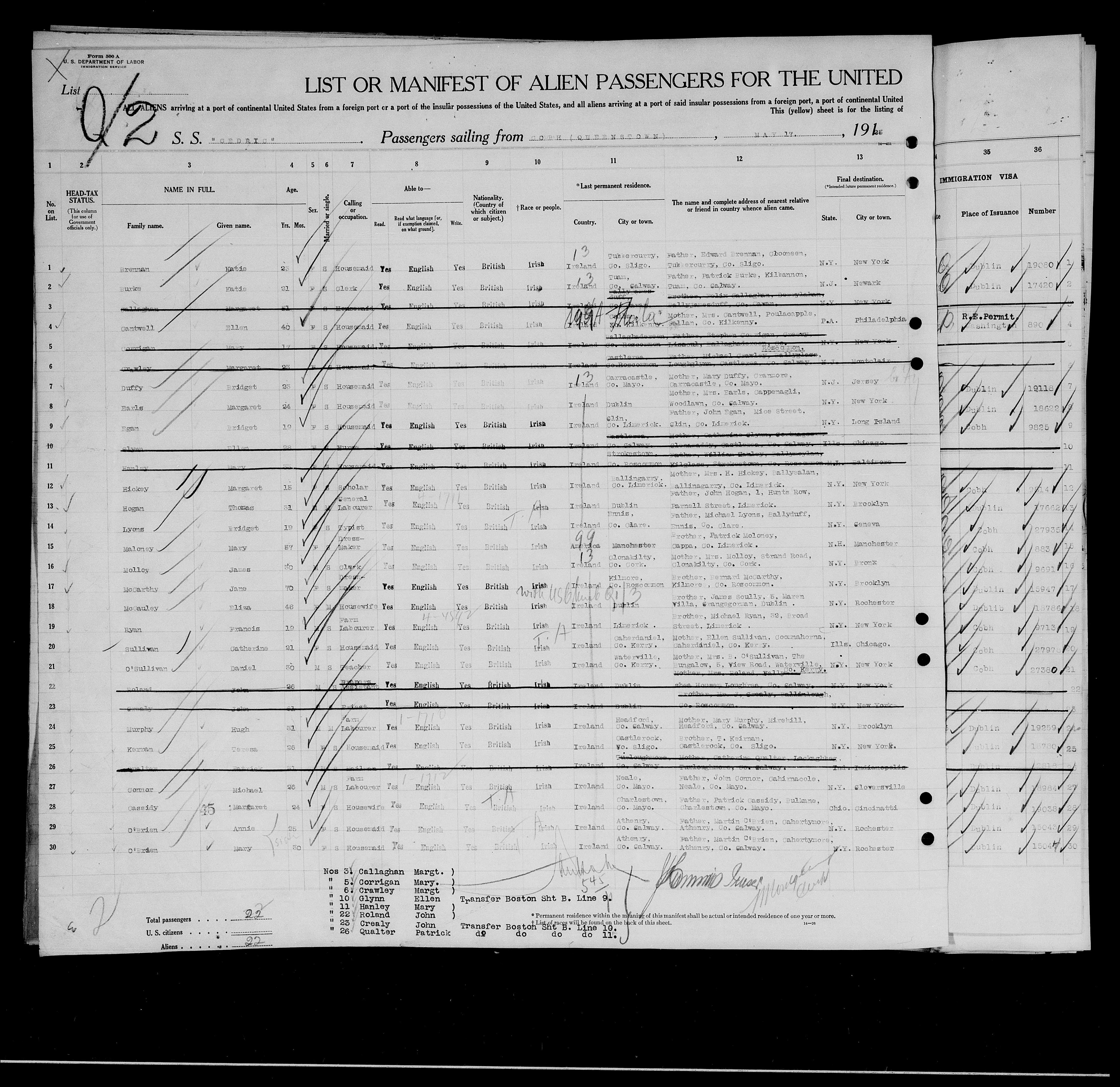
On 25 May 1925, the SS Cedric, a White Star Line vessel, arrived at the Port of New York with 1,200+ passengers. Among them was Margaret Cassidy, age 25, listed on the manifest as having "British" nationality and "Great Britain" as her last place of residence. To anyone searching Ellis Island records using the filter "Ireland" as birthplace, she would be invisible.
Why "British"?
The classification of Peggy as "British" is not an error; it reflects immigration practice of the era. Like her future husband Philip, Peggy had spent time in England before emigrating to America. She may have boarded in Liverpool, she may have worked there temporarily, or she may have simply traveled through English ports en route to America. Under immigration rules of 1925, last place of residence determined nationality classification. The consequence was that she disappeared from Irish genealogy databases.
Irish emigrants who traveled via England were systematically harder to trace. Ellis Island's search interface filters by birthplace, and if an immigrant's last place of residence (and thus their indexed nationality) was England, they would be missed by anyone searching for "Ireland" arrivals. This pattern affected multiple members of both the Gaffney and Cassidy families and demonstrates how emigration records, while abundant, require creative searching and an understanding of historical classification systems.
Coordinated Emigration
What makes Peggy's crossing particularly significant is its timing. Philip arrived on 10 March 1925. Peggy arrived on 25 May 1925. That is just 76 days later—ten and a half weeks. The arrival dates are too close to be coincidence.
Philip emigrated first, likely scouting a route and confirming employment in Chicago. Once he sent word that passage was available or employment arranged, Peggy followed. By June, they were married in Cincinnati. By May 1930, they had a daughter. The speed of their union—courtship, engagement, and marriage all accomplished within months of arrival—suggests either a prior arrangement in Ireland or a degree of Irish-American community matchmaking that would have been entirely normal at the time.
Cincinnati: Where the Lines Met
By 1929, Philip “Finny” Francis Cassidy and Margaret Mary “Peggy” Cassidy were married in Cincinnati. They had met either in the few weeks after arrival or through family networks that spanned the Mayo countryside and the Ohio industrial belt. What is certain is that two unrelated Cassidy families from the same parish area had each sent their youngest children to America, and those children had found each other.
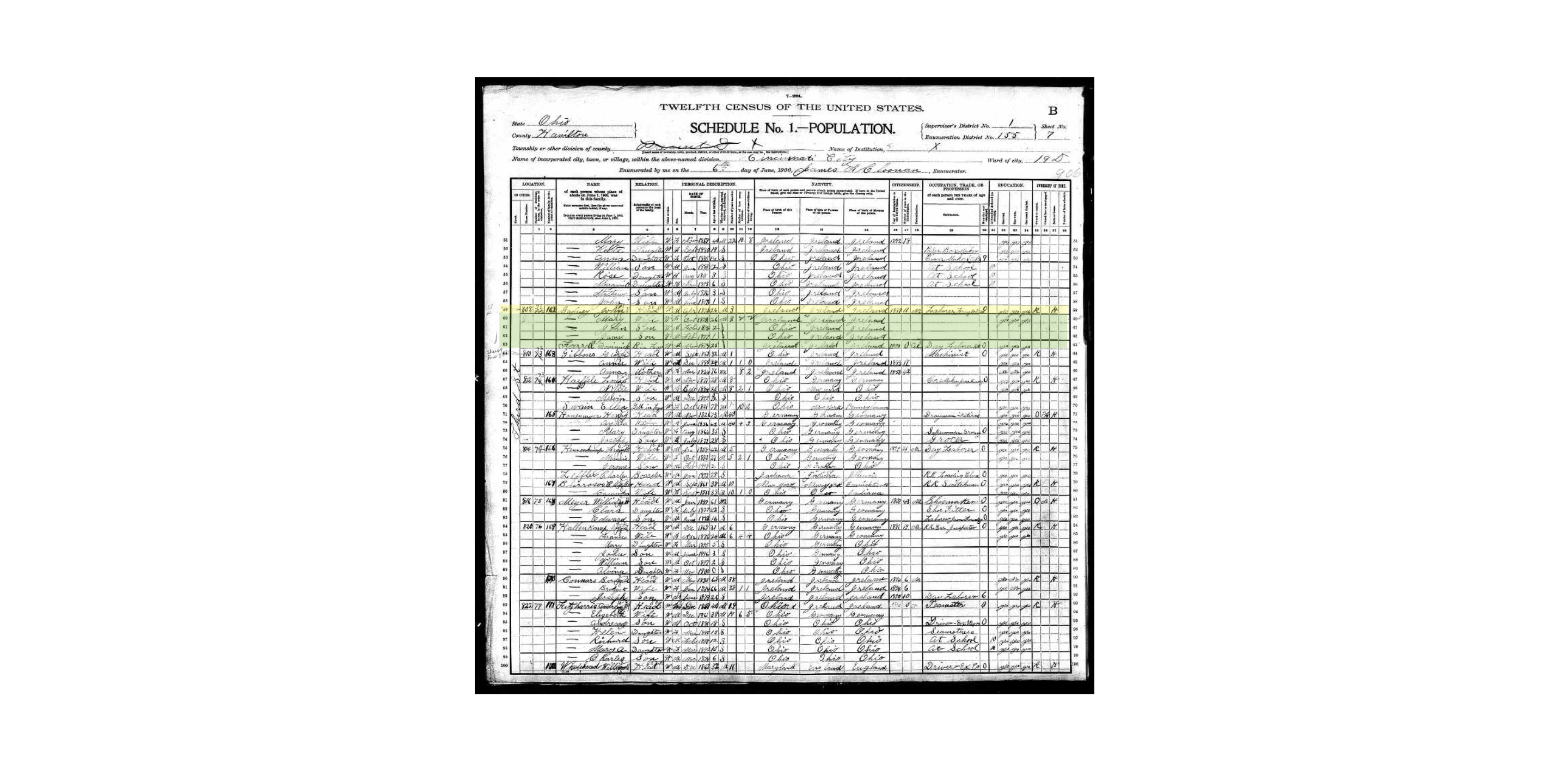
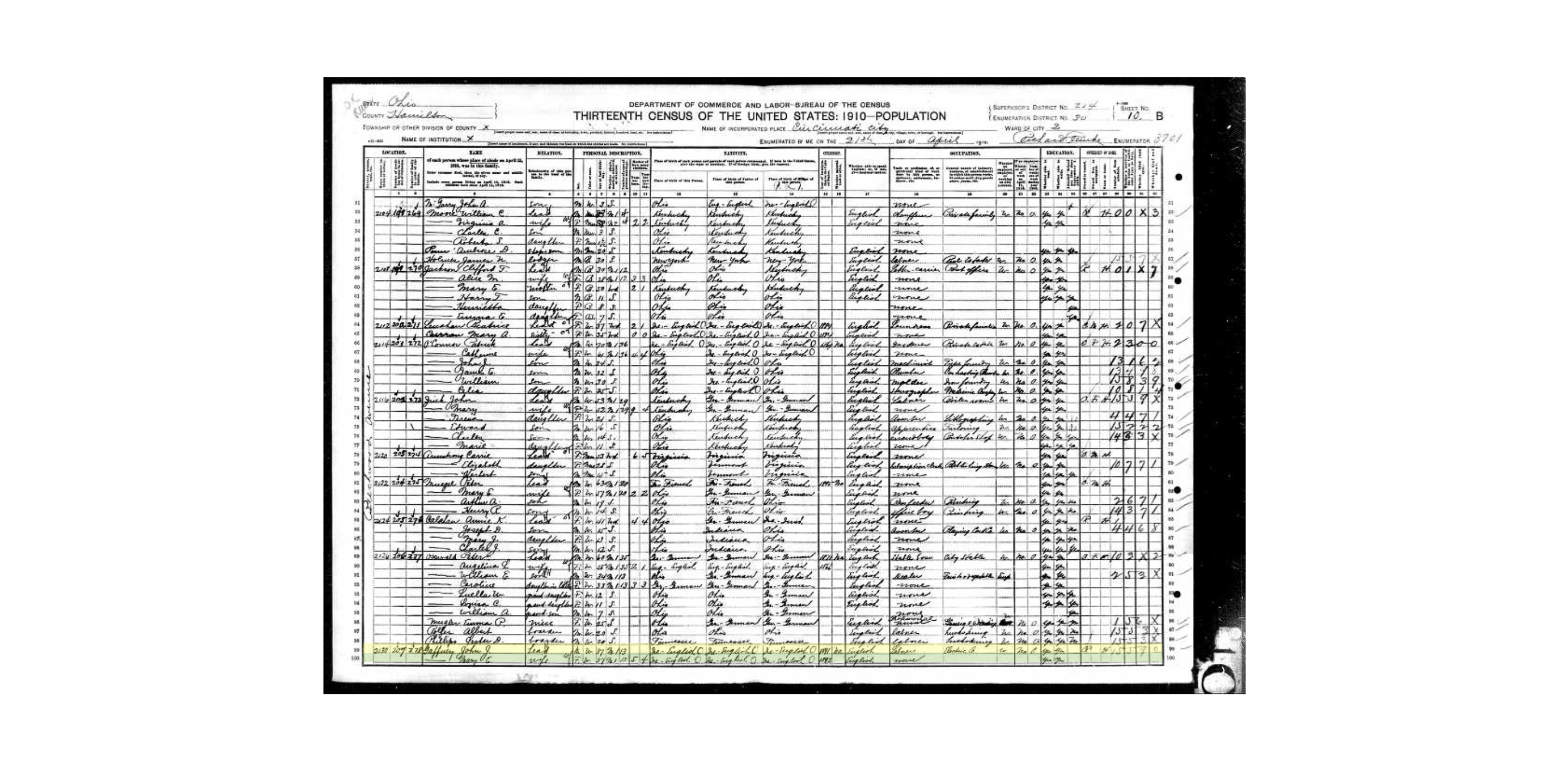
Cincinnati in the 1920s was a center of Irish-American life. The city had hosted Irish immigration since the 1840s. By the 20th century, established Irish enclaves existed throughout the city and nearby Toledo. The Scanlon family—with whom Martin and Peter Cassidy had boarded—was one of hundreds of Irish households that provided the crucial first step for new arrivals: lodging, job leads, and introduction to Irish parishes and social organizations.
The Scanlon Connection
Martin Cassidy (b. 1879) and his younger brother Peter (b. 1888) both boarded with the Scanlon family in Cincinnati in 1910. The Scanlons were likely a fellow Irish family, possibly distant cousins or townland neighbors from Mayo. The significance of this connection deepened a generation later: in 1891, Margaret Scanlon married John Gaffney (son of Patrick of Cuilmore), in the Gaffney family research. The same Scanlon surname appears in both family lines, separated by geography and a generation. Whether the Cincinnati Scanlons were related to the Sligo Scanlons remains a tantalizing open question.
Philip and Peggy's marriage on 5 June 1929 represented a union of two Irish immigrant households. Their daughter Mary Theresa, born 21 May 1930 in Toledo, Ohio, was fully American— born in the United States to immigrant parents, she would inherit a dual legacy: the oral history of rural Mayo and the lived experience of Midwestern industrial America.
Philip worked as a foundry worker, a common occupation in Toledo's steel and manufacturing industries. This work was steady but demanding—heat, noise, and physical strain. Yet it provided the wages that allowed him to naturalize, own a home, raise a family, and eventually sponsor the immigration of other family members. By American standards of the era, he had succeeded.
The Healy Connection: Carracastle to Cincinnati
When James William Gaffney married Delia Rushe on 30 August 1918 in Cincinnati, he was nineteen years old and marrying into a family whose roots tangled with his own in ways neither may have fully understood.
Delia Rushe — baptised Bridget, but known all her life as Delia after her mother — was born in 1899, the daughter of James Rushe and Delia Healy of Carracastle, Co. Mayo. Her mother had emigrated to America in 1916, sailing on the SS Philadelphia from Dublin through Liverpool to New York on 3 August, traveling with her baby daughter. The passenger manifest listed her father as James, of Carracastle.
This is where the thread runs back to Ireland. In 1887, a James Healy had married Mary Gaffney—a daughter of Andrew Gaffney of Falleens—on 10 January 1887 at a church in the Gurteen registration district. The witness was Thomas Gaffney. Carracastle is only about fifteen kilometres from Falleens, and the Healy surname in that small a radius is more likely to indicate family than coincidence.
If Delia Healy’s father James is the same James Healy who married into the Gaffney family in Ireland, then the 1918 Cincinnati wedding created a remarkable loop: a Healy married a Gaffney in Sligo in 1887, and a Healy descendant married a Gaffney again in Ohio in 1918. The emigrant network was not just reproducing itself—it was closing circuits that had been opened a generation earlier on the other side of the Atlantic.
The Scanlon Connection: Boarders and Bridges
The Scanlon family of Cincinnati appears at a critical junction in both the Gaffney and Cassidy stories—and the question of whether they are the same Scanlons who appear in Irish records remains one of this research’s most tantalising loose threads.
In the 1910 U.S. Census, Martin Cassidy (b. 1879) and his younger brother Peter Francis Cassidy (b. 1888) are both listed as boarders in Cincinnati Ward 16 with the household of John Scanlon and Mary Scanlon. The Scanlons were a fellow Irish family providing the classic first step for new arrivals: a room, meals, and introductions to the local Irish community. Martin had arrived in 1903 and Peter in 1906—by 1910 both were settled, working, and living under the Scanlon roof.
A generation earlier and 3,500 miles away, a Margaret Scanlon had married John Gaffney (son of Patrick of Cuilmore) on 18 February 1891 at Kilfree Chapel in the Gurteen parish, Co. Sligo. The witnesses were Pat Casey and Winifred Scanlon—the bride’s relative. This John Gaffney was a widower; his first wife, Ann Flaherty, had died before 1891.
Two Scanlons, One Question
Were the Cincinnati Scanlons related to the Sligo Scanlons? The name is common enough in the west of Ireland that coincidence is possible. But the geographic overlap is striking: the Kilfree/Gurteen area is the same registration district where the Gaffneys were rooted, and the Cassidys came from just over the county line in east Mayo. If the Cincinnati Scanlons had come from the same area, they would have been a natural landing point for new arrivals from the home parishes. Boarding with “your own people”—meaning people from your townland, parish, or at least your county—was the standard pattern. The Scanlon household in Cincinnati may have been exactly that kind of safe harbour.
What makes this connection worth pursuing is not just the shared surname but the function the Scanlons served. They were the bridge between Ireland and America for at least two Cassidy brothers. If they were also connected to the Margaret Scanlon who married into the Gaffney family, then the boarding arrangement was not random—it was the emigrant network doing what it always did: taking care of its own.
The Next Generation in Cincinnati
The children of John Gaffney Jr. and Mary Farrell—born between 1898 and 1903—represent the first fully American generation of the Falleens Gaffneys. John Joseph Jr. (1898–1942), James William (1899–1990), William Patrick (1901–1951), and Mary Helen (1903–1981) grew up in downtown Cincinnati, were baptised at St. Patrick’s Church, attended local schools, and came of age during the First World War.
Their lives unfolded across the industrial heartland. John Joseph married Loretta Kohus and lived in Hyde Park; James married Delia Rushe (the Healy connection) and eventually moved to Lima; William worked at the Cincinnati Milling Machine Company; Mary Helen married James P. Gilligan and settled in Montgomery. Two brothers died young—John Joseph at 44, William at 50. James, the quiet one, lived to ninety-one.
Andrew Gaffney Jr.: The Merchant Sailor
While the Cassidys executed their chain migration to Cincinnati with documentary evidence at nearly every step, the Gaffneys' emigration was far more opaque. Andrew Gaffney Jr., born c. 1860 to Andrew Gaffney of Falleens, took a different path entirely: the sea.
In 1878, at approximately eighteen years old, Andrew Jr. joined the Merchant Navy, the commercial shipping service that employed millions of British and Irish sailors. His first recorded vessel was the Arethusa, which departed from the port at Sligo. From there, his record grows fuzzy.
An entry in the FindMyPast Ireland Merchant Navy Crew Lists (1863–1921) confirms Andrew Gaffney Jr.'s service aboard the Arethusa. Merchant navy records were meticulous about age, birthplace, and vessel assignments, but they tell us little about a sailor's private life or ultimate fate. What we know is that he:
- Was born c. 1860 in Sligo
- Joined the merchant navy in 1878
- Served aboard the Arethusa from Sligo port
- Was eventually discharged to the United Kingdom
- Disappeared from all subsequent Irish civil records
Unlike his brother John Jr., who emigrated directly to Cincinnati and left naturalization papers, Andrew Jr. vanished into the itinerant world of merchant sailors. He may have settled in England or Scotland. He may have emigrated further to America, Australia, or elsewhere. He may have died at sea. Without further records—UK census entries, ship manifests, or death registrations—his story remains incomplete.
Andrew Jr. represents a class of Irish emigrants who left few traces. He did not naturalize in America, did not establish a family line that continued into the 20th century, and did not leave letters home or naturalization papers. He was one of millions of young men who left Ireland in the late 19th century, sought work wherever the winds and wages took him, and either returned home or were absorbed into working-class communities in the empire's far reaches.
The "British" Problem: How Irish Emigrants Became Invisible
One of the most frustrating discoveries in this genealogical research emerged from immigration records: Irish emigrants who traveled via England were systematically misclassified.
Both Philip Cassidy (SS Celtic, March 1925) and Peggy Cassidy (SS Cedric, May 1925) were indexed as having "British" or "Great Britain" as their birthplace and last residence. This was not a clerical error—it was immigration procedure. Under Ellis Island rules, the nationality listed on a passenger manifest was determined by the traveler's last place of residence, not their birthplace. If someone had recently lived or worked in England, they were classified as "British," regardless of where they were born.
For genealogists searching the Ellis Island or National Archives databases, this creates a profound problem. A researcher searching for "Ireland" as a birthplace will miss anyone who departed from a British port or had a recent English residence. The remedy requires:
- Broader searches: Use UK-based databases like FindMyPast's BT 27 Outward Passenger Lists, which record people leaving Britain for America
- Searching by name alone: If you know an approximate arrival date, search by surname and given name without restricting by origin
- Cross-referencing with other documents: Naturalization papers, census records, and church documents will confirm true origin
- Understanding historical context: Ireland was part of the United Kingdom until 1922; no passport or immigration controls existed for Ireland-to-England travel
The irony is poignant: the two Cassidy emigrants who left the most documentary traces—Philip's naturalization papers and Peggy's manifest—were nearly lost to history because they took the common route of settling in England before emigrating further. Had Meghan not discovered the naturalization certificate naming Peggy and providing her true birthplace, Margaret Cassidy might have remained a phantom in American records, a woman who married an Irish immigrant and had a child but left no traceable passage home.
The Common Travel Area Context
Before Irish independence in 1922, Ireland was politically part of the United Kingdom. Irish citizens could travel freely to England, Scotland, and Wales with no passport or visa. After 1922, the Irish Free State was independent, but the Common Travel Area agreement (1923) maintained unrestricted travel between Ireland and the UK. This meant that Philip's move to Birmingham and Peggy's (presumed) time in England left no immigration trails—they were simply moving within the British Isles. Only when they boarded ships bound for America did they enter the immigration systems that leave records.
Continue Exploring
Learn more about the families:
- The Family Tree — Visual chart of all family connections across generations
- The Gaffney Story — Deep dive into the four brothers of Falleens and their dispersal
- The Cassidy Story — The two unrelated Cassidy families of Charlestown and Carracastle
- John Joseph Gaffney Jr. & Siblings — The first American-born generation of the Falleens Gaffneys