The Fight for Ireland
Family in the War of Independence, 1919–1922
Between 1919 and 1922, the families of Falleens, Gort, and east Mayo took up arms for Irish independence. From military officers to ambush fighters, from court defenses to acts of civilian courage, the Gaffneys and Cassidys contributed to the struggle that would change Ireland forever.
A Family at War
The War of Independence arrived at every door in Sligo, Leitrim, and Mayo. For the Gaffney and Cassidy families, it meant brothers and cousins choosing sides, young farmers taking officer commissions, and women organizing support networks. The struggle was personal, local, and costly.
Both branches of the family had men—and women—actively engaged. The Gaffneys of Gort produced IRA officers commanding companies. The Cassidys of Charlestown and Carracastle fought in ambushes and coordinated military operations across the brigade. The Gaffneys of Falleens connected to both: through marriage, through geography, and through shared commitment to the cause.
What follows is their story, told through military records, civil court documents, and the people who lived it.
The Gort Officers
The townland of Gort in Co. Leitrim, nestled near Jamestown, became the headquarters for a remarkable command structure. Michael Gaffney and his wife Mary Anne Fitzsimmons raised sons who would lead the fight for their county.
Michael Gaffney and Mary Anne Fitzsimmons
Michael Gaffney was born around 1855 in Gort, Co. Leitrim. He married Mary Anne Fitzsimmons on 20 January 1890 in Aughrim parish, Co. Roscommon. Together, they built a family and a household that would become a meeting place for independence work.
In the 1901 census, the family was recorded at House 7 in Gort, with Michael and Mary Anne, their children, and Michael's elderly mother from Roscommon. By 1911, they had moved to House 652580 but remained in the same townland. Through it all, they were raising two sons who would become IRA officers.
John Joseph Gaffney — IRA Captain
Born: 16 October 1894, Gort, Co. Leitrim
Position: IRA Captain, Jamestown Company
Military Record: Captain, Jamestown Company
John Joseph Gaffney held the rank of Captain and commanded the Jamestown Company during the War of Independence. His command stretched across a difficult geography: the area around Jamestown in central Leitrim, a region of small roads and larger ambitions.
One of his officers was John Hunt of Mullaghroe, who held the rank of 1st Lieutenant. Hunt had married John Joseph's aunt—Maggie Gaffney—in 1900, creating a family bond that transcended rank and made the military hierarchy more than formal titles.
John Joseph was a civil registrant, meaning his birth and place were recorded in the official record books. He came of age in a Gort household where independence was discussed, debated, and ultimately, acted upon. By 1919, when the War of Independence began in earnest, he was ready.
Tom Gaffney — IRA 2nd Lieutenant
Born: 16 November 1897, Gort, Co. Leitrim
Position: IRA 2nd Lieutenant
Military Record: 2nd Lieutenant
Tom was the younger brother, born three years after John Joseph. He served as a 2nd Lieutenant, likely under his brother's command or in a company adjacent to Jamestown. The two brothers represented a continuity of military leadership in the Gort area—young men from the same household, trained by the same experiences, committed to the same cause.
By family tradition, he was named Thomas after his older brother Thomas, born in 1890, who had died in infancy. The name carried memory and meaning in the small townland of Gort.
The Hunt Connection
John Hunt of Mullaghroe was a man of paradoxes. He was a farmer, a father, a family man—and during the War of Independence, he was a 1st Lieutenant commanding troops in the Jamestown Company.
An Unlikely Officer
Born: circa 1865
Residence: Mullaghroe, Co. Sligo
Married: 26 February 1900, Mullaghroe, to Margaret "Maggie" Gaffney
(daughter of Patrick Gaffney of Cuilmore)
IRA Rank: 1st Lieutenant, Jamestown Company (under Captain John Joseph Gaffney)
The Age Question
John Hunt was approximately 55 years old during the War of Independence—an unusually advanced age for active military service. Most IRA volunteers were in their teens, twenties, and thirties. Hunt's presence in an officer position at this age, commanding men from a different county, suggests more than a marriage connection to the Gaffneys.
The evidence points to personal trust, family loyalty, and military skill that transcended the typical volunteer role. Hunt may have been a mentor figure, a skilled organizer, or both.
Family Connections
In 1901, Hunt's household in Mullaghroe included his wife Maggie (30), his parents Denis (95!) and Mary (83), and two nieces. By 1911, the parents were gone, and Hunt and Maggie had four children of their own: Mary J., Pat William, Catherine, and John.
His marriage certificate from 1900 shows witnesses including James Casey, connecting the Gaffney-Hunt household directly to the Casey family—Jane Casey Gaffney's relatives, likely cousins or neighbors.
Maggie's Courtroom Fight
While John fought in the countryside, Maggie took action in the courtroom. In 1920, during the War of Independence, Maggie Hunt filed complaints against an English neighbor named Reycroft, accusing him of "threatening and abusive language." She brought her case before Sligo Borough Court and Ballymote Court.
Maggie was also fined for an unregistered dog—a small matter, but the records show a woman actively engaged in community disputes, unafraid of authority, during a dangerous period. This is the domestic face of the independence struggle.
Three Cassidy Brothers
In the East Mayo Brigade of the IRA, three brothers from the Cassidy family served in different companies. Their father, Patrick Cassidy Sr., had died in 1873, but the republican commitment had not died with him. His sons took it up and carried it forward.
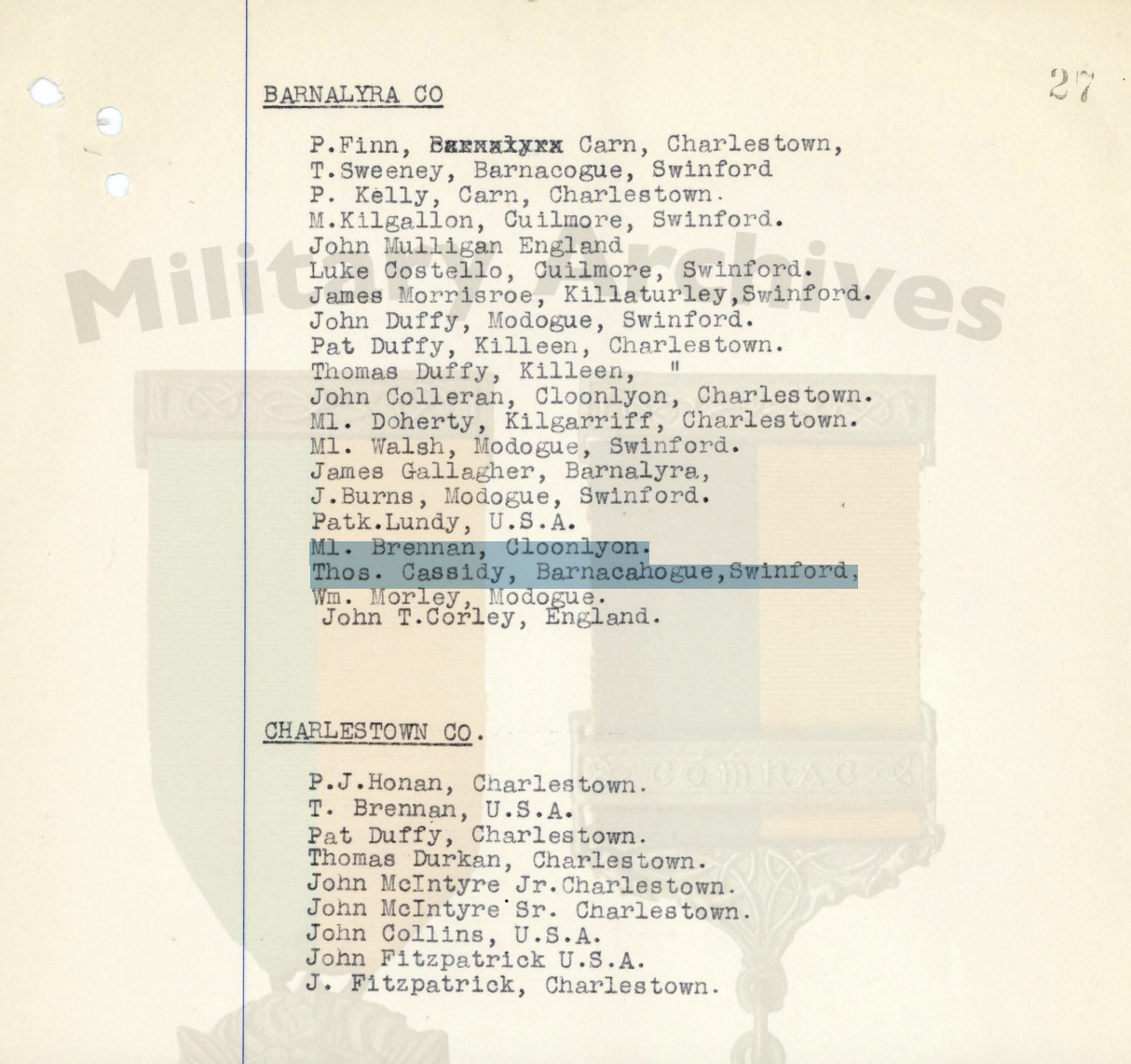
Thomas Cassidy — Barnalyra Company
Born: 18 January 1876
Company: Barnalyra Company, 1st Battalion, East Mayo Brigade
Address: Barnacahogue, Swinford
Service: 1919–1922
Military Record: Barnalyra Company
Thomas was the eldest of the three brothers. By the time of the 1901 census, he had already left the family home at Bullaun and was living elsewhere. When the War of Independence began, he was in his mid-40s—like John Hunt, an older volunteer—living near Swinford.
His appearance in the Barnalyra Company rolls indicates participation in the 1st Battalion, which covered Swinford, Charlestown, and the surrounding areas.
Patrick Jr. Cassidy — Carracastle Company, Three Operations
Born: 4 July 1890
Company: Carracastle Company, 2nd Battalion, East Mayo Brigade
Address: Carracastle, Ballaghadereen
Rank: Active combatant
Military Record: Three Combat Operations
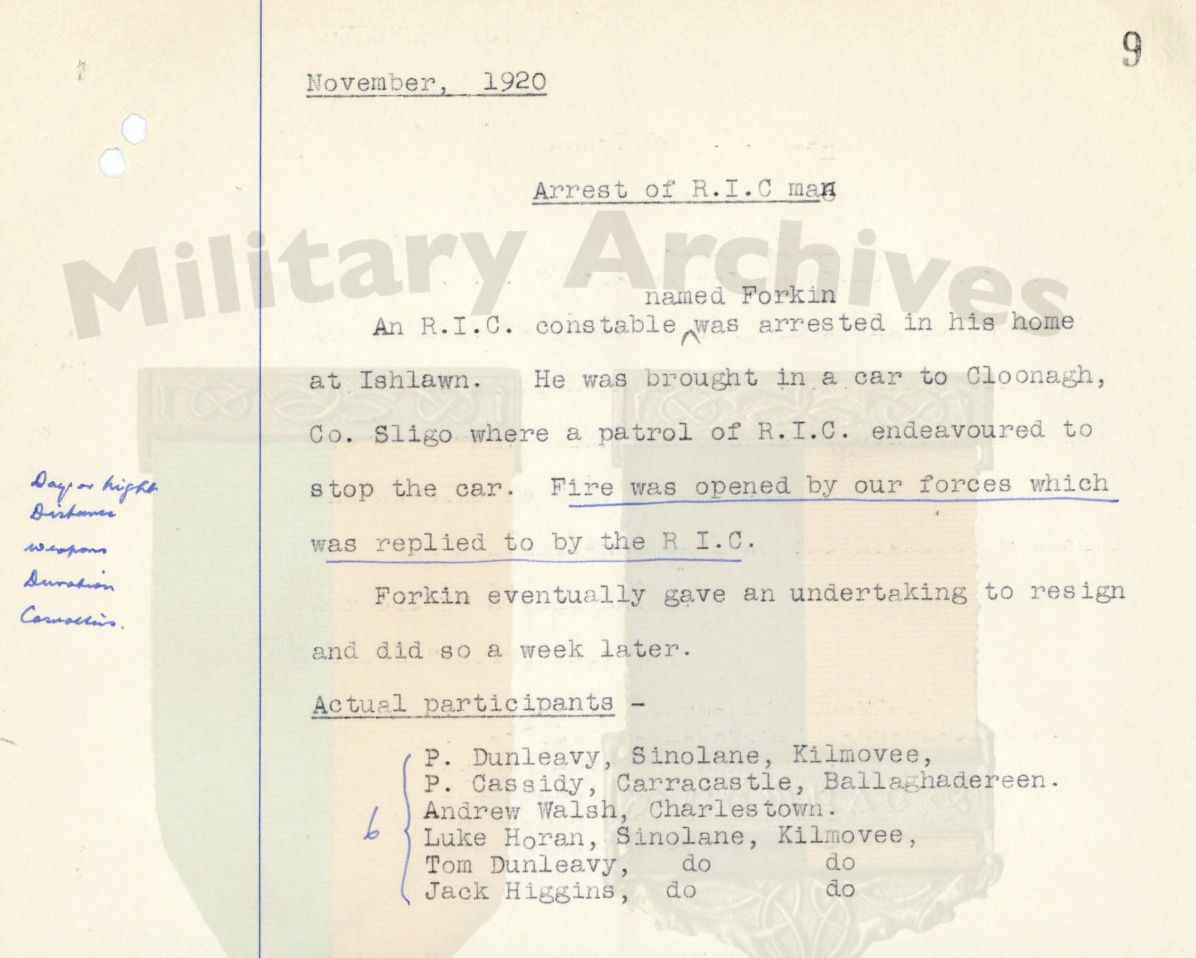
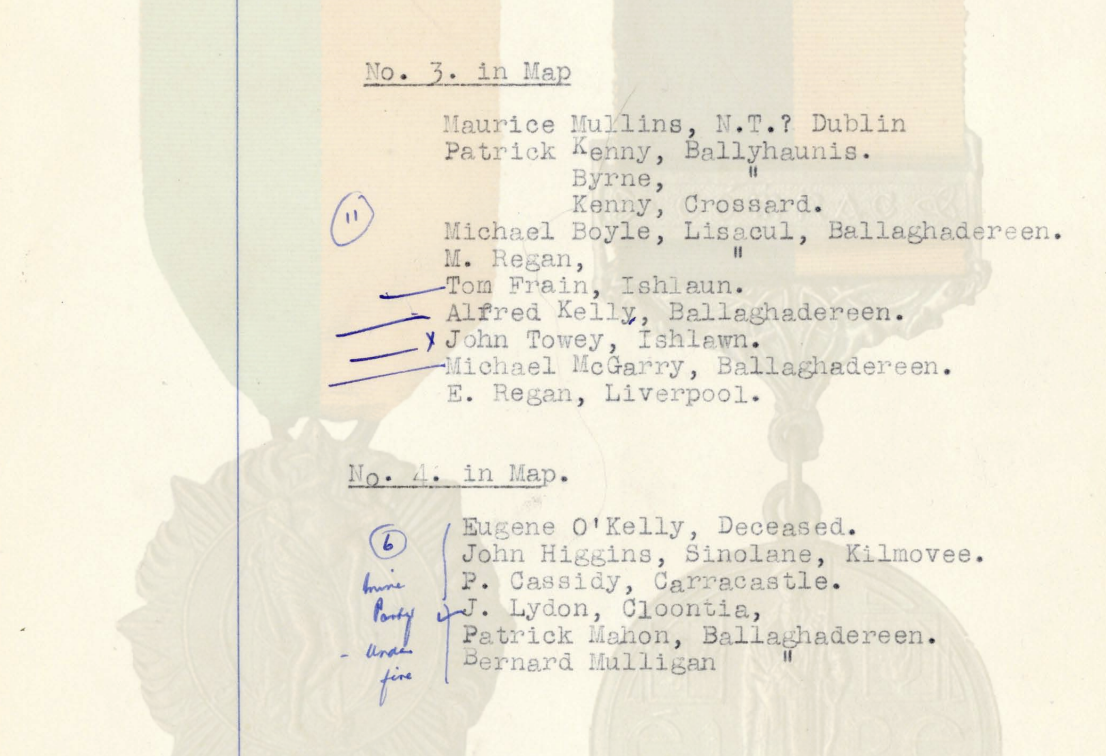
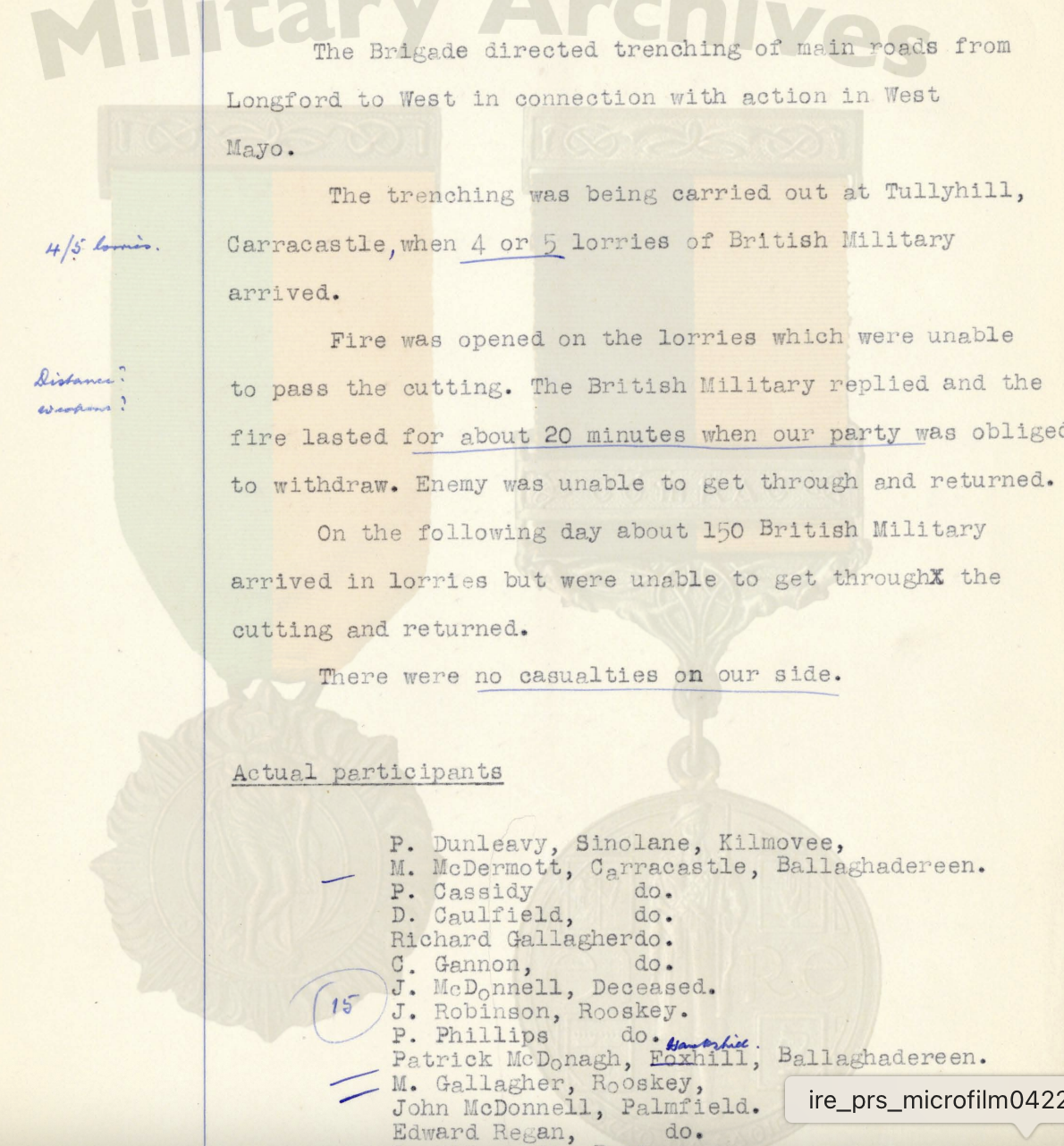
Patrick Jr. was the most documented of the three brothers. The East Mayo Brigade A33 file records him participating in at least three significant operations:
- Arrest of RIC Constable Forkin at Ishlawn, November 1920. A direct action against the police force occupying Ireland.
- Mine party and barracks attack. Coordinated explosive work, likely targeting a military installation.
- Ambush at Tullyhill, Carracastle. A sophisticated military engagement: the road had been trenched (defensive fortifications dug into the earth), creating a kill zone. The firefight lasted approximately 20 minutes against 4–5 lorries of British military personnel. This was not a skirmish—it was a planned, disciplined engagement.
Patrick Jr. was a farmer's son in 1911, age 20, living at Bullaun with his parents. A decade later, he was a combat veteran.
Michael Cassidy — Carracastle Company
Born: 11 September 1892
Company: Carracastle Company, 2nd Battalion, East Mayo Brigade
Address: Palmfield
Role: Company member, area duties
Military Record: Carracastle Company
Michael served in the same company as his brother Patrick Jr., but in Palmfield, a different townland within the company's area. By 1911, Michael was 19 years old, living at Bullaun. The Carracastle Company was the largest in the 2nd Battalion (919 members in 1921), covering a wide area of east Mayo.
Michael's duties included responsibilities for the area around Palmfield—logistics, training, recruitment, or specific operational tasks not detailed in the surviving records.
Connected Names and Networks
The Cassidy brothers did not fight alone. The military records reveal a network of related families, neighbors, and friends—all engaged in the struggle.
Kilgallon — Bridget's Relatives
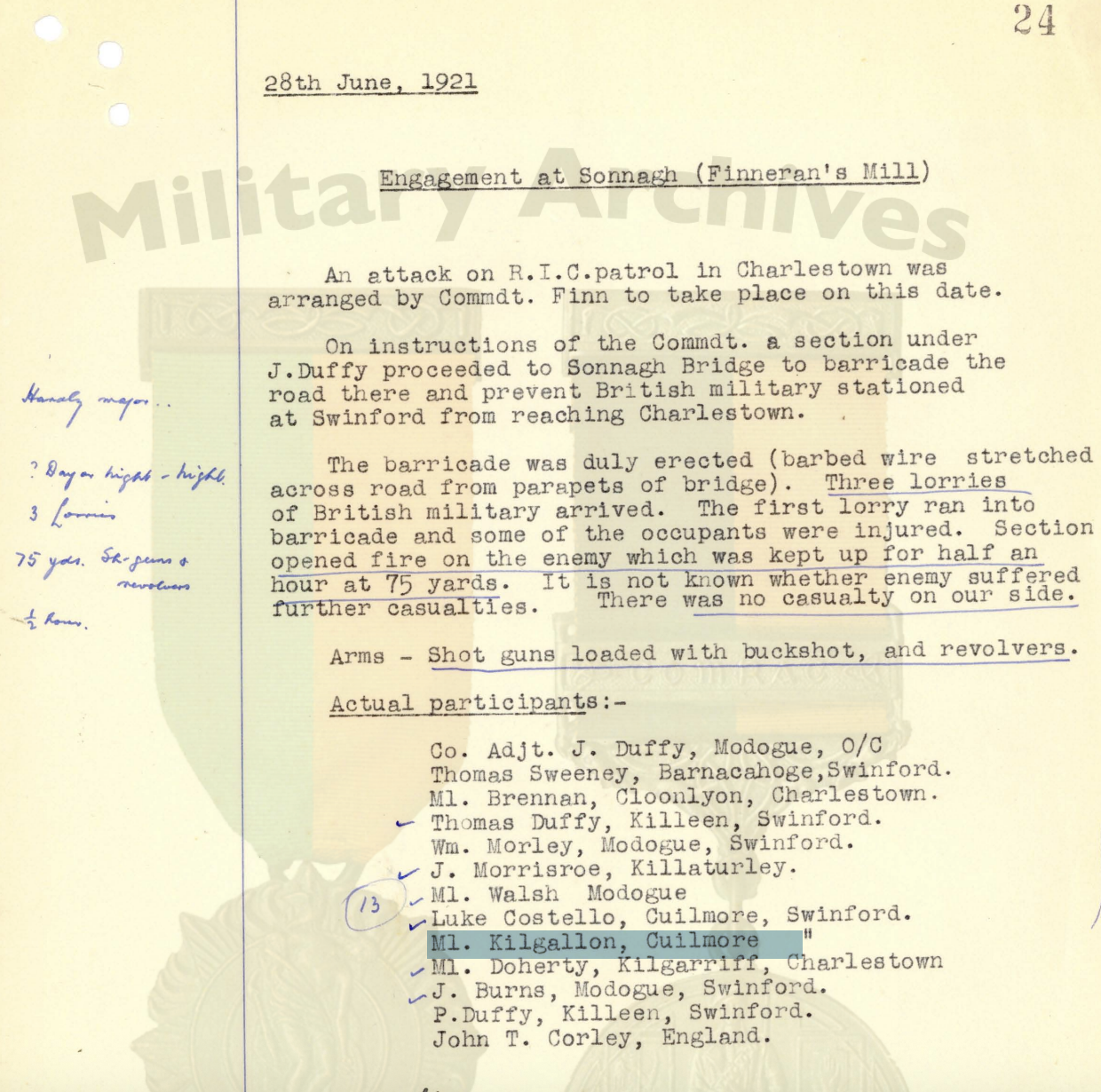
M. Kilgallon, Cuilmore, Swinford appears in the East Mayo Brigade records, participating in at least two operations, including the Sonnagh/Finneran's Mill engagement on 28 June 1921—a 30-minute firefight with an RIC patrol.
Kilgallon was almost certainly a relative of Bridget Kilgallon, who married Patrick Cassidy Sr. and became the mother of the three IRA brothers. The surname cluster in Cuilmore (the Gaffney family townland) suggests extended family connections—cousins and brothers-in-law fighting in the same company, in the same brigades, with the same commitment.
Doherty, Duffy, and Mulligan
M. Doherty, Kilgarriff, Charlestown appears in Barnalyra Company—possibly related to Annie Doherty, who married John Cassidy and became the mother of another line of the family.
The Duffy surname recurs repeatedly in the military records and in the baptism records of the Cassidy children—appearing as sponsors and witnesses. Bernard Mulligan served in a mine party with Patrick Jr. Cassidy, and Mulligan was the maiden name of John Cassidy's wife's mother, according to genealogical records.
These are not random names. They are family members, in-laws, and neighbors—communities of people bound by blood, marriage, and shared political conviction.
John Hunt of Carracastle
A John Hunt of Sraugh, Carracastle served in the Rooskey Company, 2nd Battalion. This is not our John Hunt of Mullaghroe (who was in Jamestown Company), but the name repetition shows the Hunt family was widespread and engaged across the brigade.
Emigrant Rolls
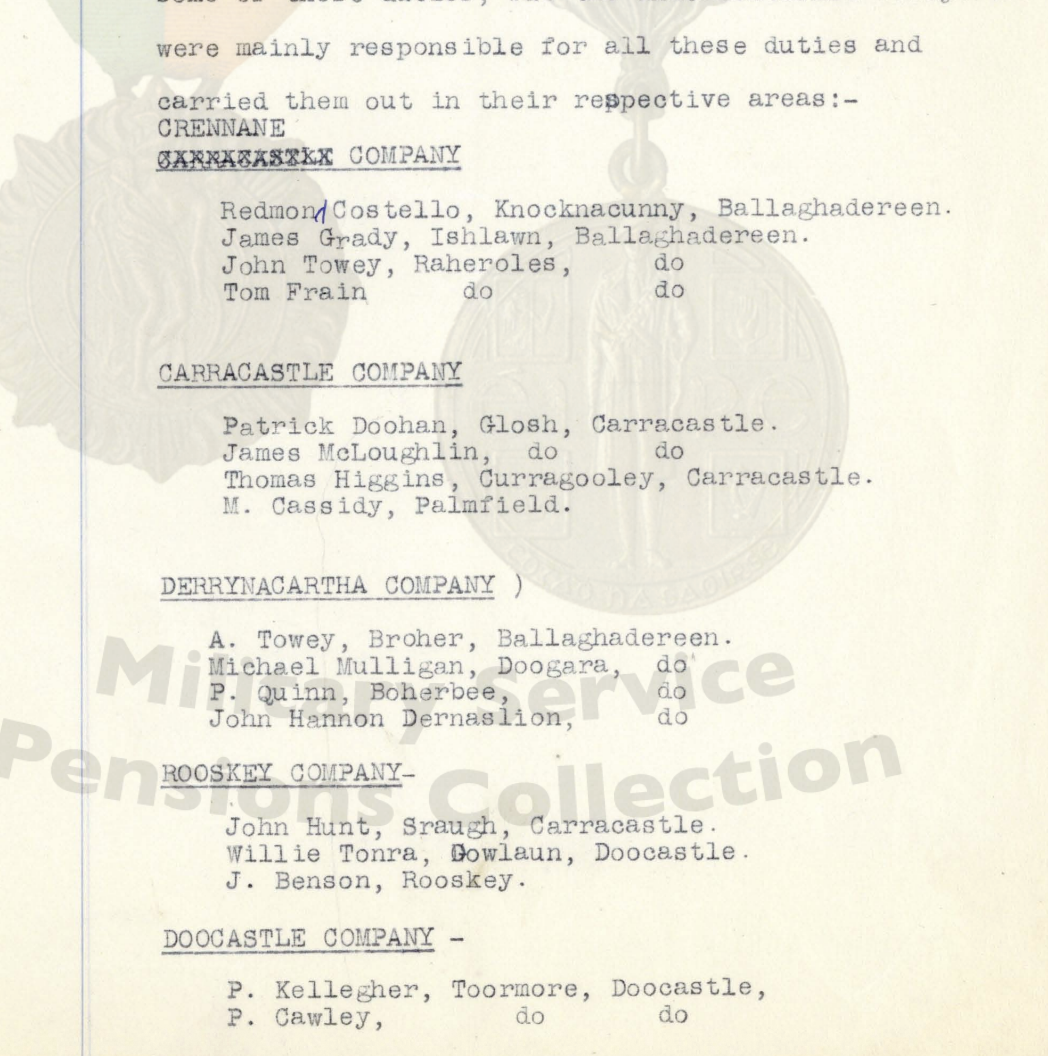
The military records also mention names of IRA members listed as living in the United States or England. The Irish independence movement maintained contact with its diaspora—and the diaspora maintained its commitment. Names like Patk. Lundy, John Mulligan, John Collins, and John Corley appear as members living in exile, still connected to their brigades.
East Mayo Brigade Structure
The Cassidy brothers and their extended family served within a larger military organization. Understanding the brigade structure helps clarify the scope and organization of their effort.
Brigade Organization
As of 11 July 1921, the East Mayo Brigade (Mayo East Brigade, part of the 2nd Western Division) was organized into four battalions:
| Battalion | Strength | Key Companies |
|---|---|---|
| 1st Battalion | 745 men | Swinford, Barnalyra, Charlestown, Killasser, others |
| 2nd Battalion | 919 men | Carracastle, Roosky, Doocastle, Lavey, others |
| 3rd Battalion | 377 men | Kiltimagh, Bohola, Kilkelly, Ballinamore |
| 4th Battalion | 317 men | Bekan, Loughboy, Knock, Ballyhaunis |
The Cassidy brothers operated within the 1st and 2nd Battalions. The total brigade strength approached 1,758 men—a considerable force distributed across a wide area of east Mayo.
Re-organization, 1922
On 1 July 1922, as the War of Independence ended and the Civil War began, the brigade was re-formed as the 5 East Mayo Brigade, 3rd Western Division. The organizational structure changed, but the commitment and the people remained.
Cumann na mBan — Women's Organisation
The War of Independence was not fought by men alone. Cumann na mBan (the women's organization of the IRA) was active, organized, and documented across the East Mayo Brigade.
Organization and Membership
Military records from 1937–1939 capture the organization's structure:
- Carracastle branch: 40 members (recorded in CMB/39)
- Swinford District Council branches: 8 branches including Charlestown, with strength growing from 279 to 489 members between 1937–1938 (CMB/29)
- President: Brid Bean Ní Cathmhaoil (President of the Swinford DC organization)
Still to Review
The CMB/29 file from the Swinford District Council contains handwritten membership lists for all branches, including the Charlestown branch. This document may reveal the names of Cassidy women and other family members who participated in the independence struggle. The records remain to be fully examined.
A Legacy of Courage
Between 1919 and 1922, the Gaffneys and Cassidys of Sligo, Leitrim, and Mayo made choices that changed their lives and shaped their nation. Some rose to officer rank. Some participated in ambushes and military operations. Some, like Maggie Hunt and the women of Cumann na mBan, fought in courtrooms and community networks.
Not all survived. Not all won permanent positions in the new Ireland. Some emigrated. Some faded from the record. But for a moment in history, they were part of something larger than themselves: a struggle for Irish independence.
Their names appear in military records, in court documents, in family stories passed down through generations. This is their history.
Learn more about these families:
The Gaffney Family Story •
The Cassidy Family Story