John "Owen" Gaffney Sr.
Vital Statistics
Owen and John — The Same Man
One of the key discoveries in the Gaffney research is this: "Owen" Gaffney in the Griffith's Valuation and "John" Gaffney in the parish records are the same person. Both are anglicizations of the Irish names Eoin or Eoghan.
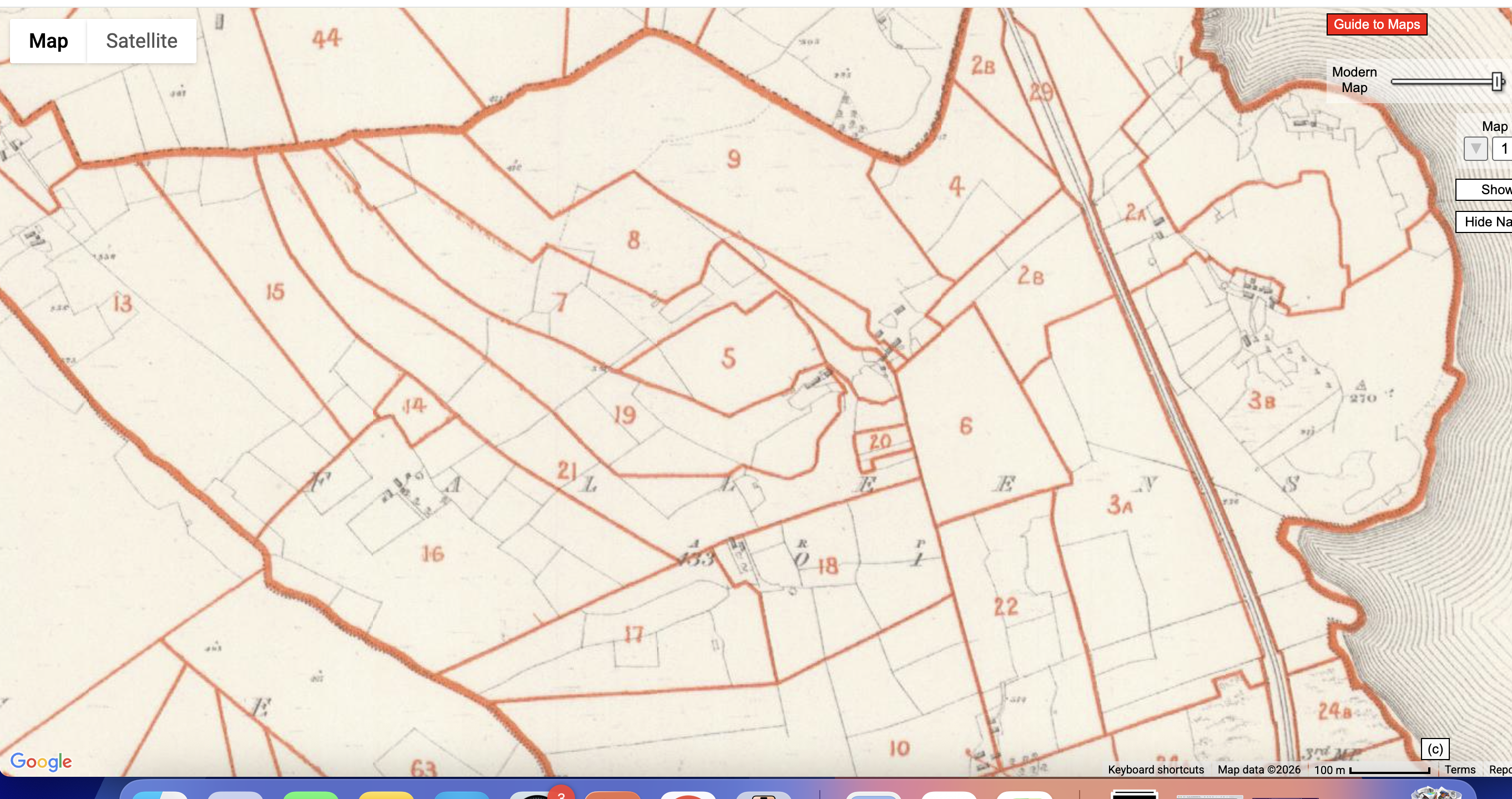
In the Griffith's Valuation survey of the 1850s, he appears as "Owen Gaffney," a tenant farmer holding two plots (19 and 20) in Falleens, Co. Sligo. He also shared the large central Plot 17 with his brothers Andrew and Patrick.
In the parish records — his children's marriages, his wife's death certificate, his family's civil registration — he appears as "John Gaffney." This is the English administrative form that dominated in official documents.
A critical clue: Zero "Owen Gaffney" baptisms exist in the entire RootsIreland index for this area. "Owen" was only ever an English anglicization. The Irish-language registers, where they survive, would have recorded him as Eoin or Eoghan Mag Shamhthain.
The Marriage to Jane Casey
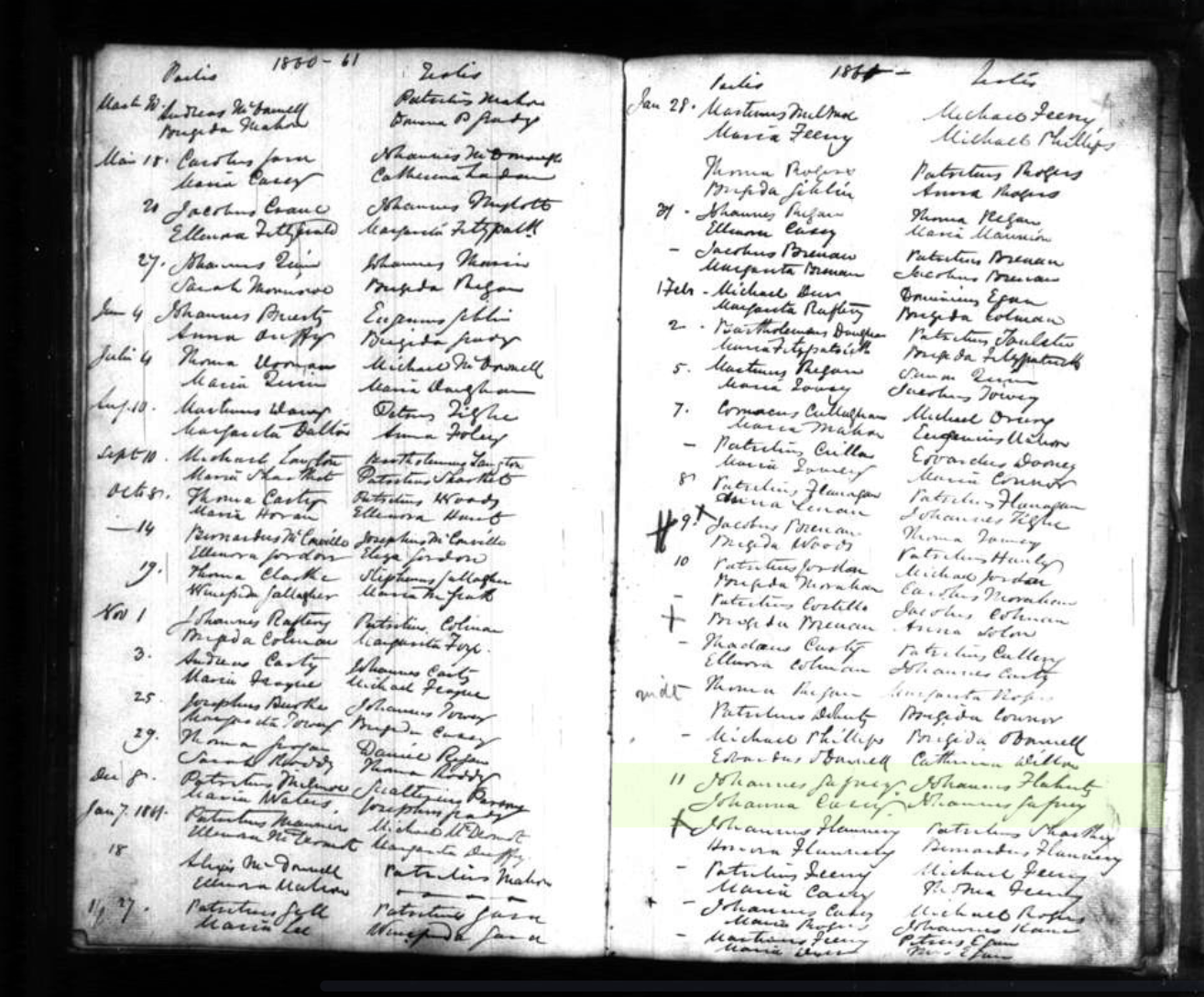
John Gaffney married Jane Casey on 11 February 1861 at Castlemore parish — the Cathedral of the Annunciation & St. Nathy in Ballaghaderreen.
The parish register lists the witnesses as John Flaherty and John Gaffney (likely his father or brother).
No civil record of this marriage exists. Irish civil registration began in 1864. This marriage, which occurred in 1861, was recorded only in the parish register — a simple list format containing the date, the parties, and the witnesses. The register does NOT include fathers' names, which would have provided a direct link to John's parents.
The Flaherty surname recurs throughout the Gaffney records. Luke Flaherty of Falleens was the father-in-law to Patrick's son John (who married Ann Flaherty in 1882). John Flaherty witnessed this 1861 wedding. These are tight-knit families in a small community, bound by blood and land.
Children
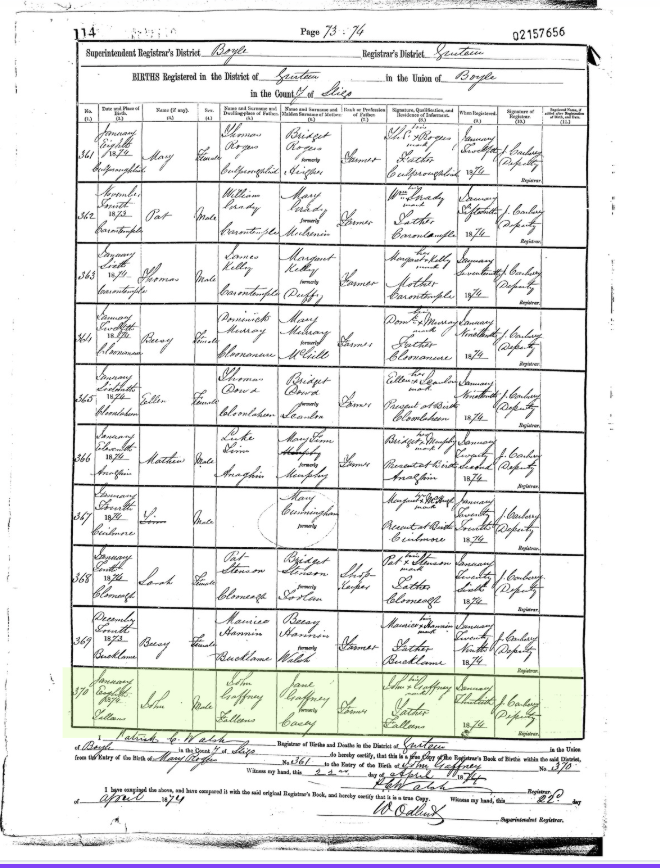
John and Jane had at least five children. Two are clearly documented in civil and military records; the others appear in marriage records and census data.
Joined the Royal Irish Constabulary (RIC), service no. 53811. Dismissed in 1893 under circumstances that remain unclear. Later moved to Leitrim and married. His son was John Joseph Gaffney (b. 1894), who became an IRA Captain in Gort, Co. Leitrim during the War of Independence.
The ancestor in Meghan's direct line. Emigrated to Cincinnati, Ohio c. 1889 and became a foundry worker. Married Margaret (Peggy) Cassidy and had multiple children.
Married John McLoughlin on 18 February 1895. Her father is listed on the marriage record as "John Gaffney," confirming his identity.
Appears as a witness at her sister Mary's 1895 wedding.
Mentioned in family records, but her adult life remains undocumented in surviving sources.
The Vanishing
John Gaffney Sr. died sometime before the 1901 Irish census. But his death was never registered with the civil authorities.
Meghan conducted an exhaustive search of all John Gaffney deaths recorded in the Boyle Subscription Registry district between 1874 and 1911 — a total of 23 results. She examined every plausible candidate, filtering by age and checking the informant details. None of them came from Falleens.
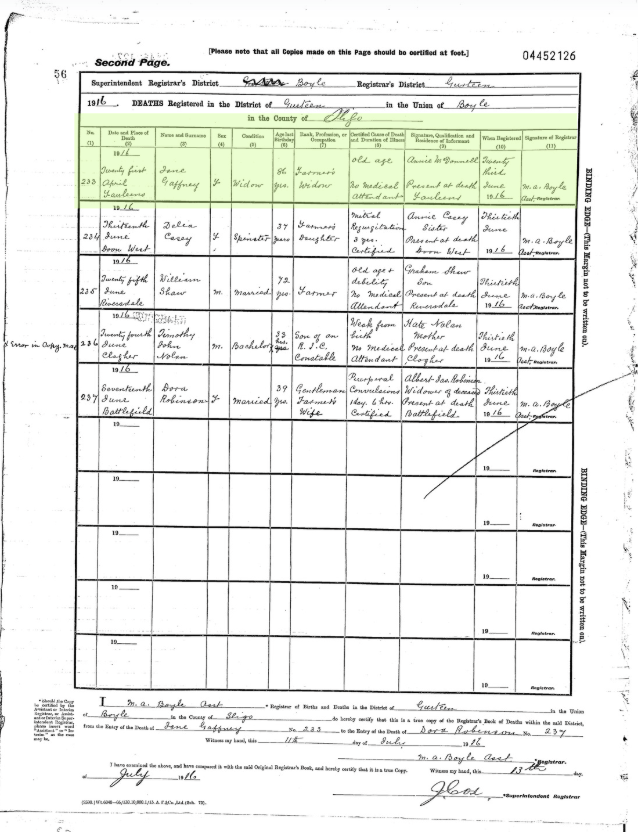
His wife Jane Casey, however, lived on. She remained in Falleens until her own death in 1916, at the age of 86. The death record lists her as a widow and gives the informant as Annie McDonnell, a neighbor.
Here lies the paradox: Irish newspapers mention "John Gaffney of Falleens" as late as 1908, testifying in a right-of-way dispute. Census enumerators never captured him on the rolls for 1901 or 1911 — neither in Falleens nor anywhere else in Sligo, Roscommon, or Leitrim. The Gaffney family was there. They were visible in the community. Yet they were not recorded.
Unregistered Deaths in Rural Ireland
Deaths were not always registered in rural Ireland, particularly among poor and elderly farmers. A death at home, with no doctor in attendance, might never reach the registrar. Jane Casey's age (86) and the fact that her death was registered suggests her death may have occurred in a hospital or workhouse, or was reported by a concerned neighbor. John Sr.'s death, years earlier, may simply have vanished into the silence of the Irish countryside.
The Balfe Estate
All Gaffney holdings in Falleens were under "Patrick Balfe (Reps)" — a bankrupt estate in the process of liquidation.
Nicholas J. Balfe owned 433 acres in Co. Sligo — essentially the entirety of the Falleens townland. This land was held by numerous tenants, among them the Gaffneys, the Caseys, and other families.
The Balfe estate was sold through the Encumbered Estates Court, a mechanism created by the British government to clear debts from Irish estates. Sales occurred in 1860 and again in 1875. With each sale, tenancies could be renegotiated or lost.
Nearby, the Land War was moving into violent territory. A Land League shooting at Coolavin killed Joseph Corcoran (of Sroove, adjacent to Falleens) and Brian Flannery — the Gaffneys' immediate neighbors. The struggle over land tenure was not abstract. It was happening on their doorstep.
The Unsolved Question
We have strong circumstantial evidence that John Gaffney Sr. and Patrick Gaffney (who lived in Cuilmore, adjacent to Falleens) were brothers:
- They held adjacent plots in Griffith's Valuation.
- They cross-witnessed at each other's family weddings.
- They lived in the same tiny community, with overlapping social circles.
- Their children married into the same families (Flahertys, Caseys, etc.).
But no single record explicitly names them as brothers.
The Castlemore parish register (where his 1861 marriage was recorded) does not include fathers' names. John's death was never registered. Patrick's death record (from 1888) lists his son Thomas as the informant but makes no mention of siblings. John's children's marriages identify him as "John Gaffney" of Falleens but provide no genealogical context that would link him to Patrick.
This remains the central unsolved question of the Gaffney research.
What Would Solve It?
The Griffith's Valuation Revision Books (held at the Valuation Office in Dublin) would show exactly when and to whom each Gaffney holding was transferred. A baptism record naming their father would prove the brotherhood definitively. Both require a research trip to Dublin's archives — a task for future investigation.