Maggie Gaffney & John Hunt
Vital Statistics — Maggie Gaffney
Vital Statistics — John Hunt
Maggie's Siblings
Margaret was not an only child. Her family at Cuilmore included:
- Thomas Gaffney — b. c. 1855. Present as an informant when his father Patrick died in 1888. Listed as "son" on the death record.
- John Gaffney — Married first to Ann Flaherty (1882), then to Margaret Scanlon (1891). Had at least one child: Patrick (b. 1892).
- Annie Gaffney — Witnessed Maggie's 1900 wedding alongside James Casey.
The Wedding at Mullaghroe
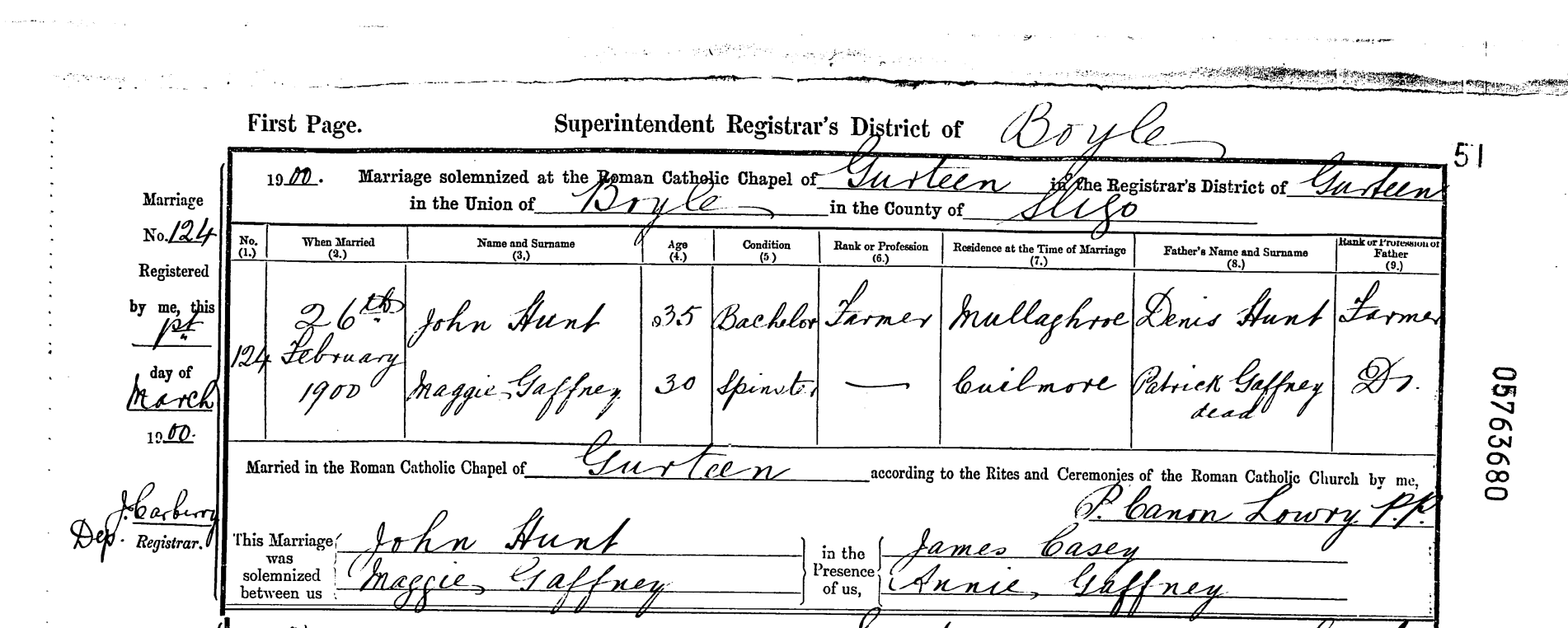
On 26 February 1900, Maggie and John married at Mullaghroe. She was 30 or 31 years old. He was 35. The marriage record preserves crucial family details:
- Groom's age: 35
- Bride: Maggie, age 30, from Cuilmore
- Father of bride: Patrick Gaffney (deceased — he had died 12 years earlier in 1888)
- Father of groom: Denis Hunt
- Witnesses: James Casey and Annie Gaffney
The presence of James Casey as a witness is significant. James was almost certainly a close relative of Jane Casey, who had married John Gaffney Sr. in 1861. This single witness name connects the Casey family to the Gaffney-Hunt wedding, bridging generations and reinforcing the closeness of the Falleens community.
The Remarkable In-Laws
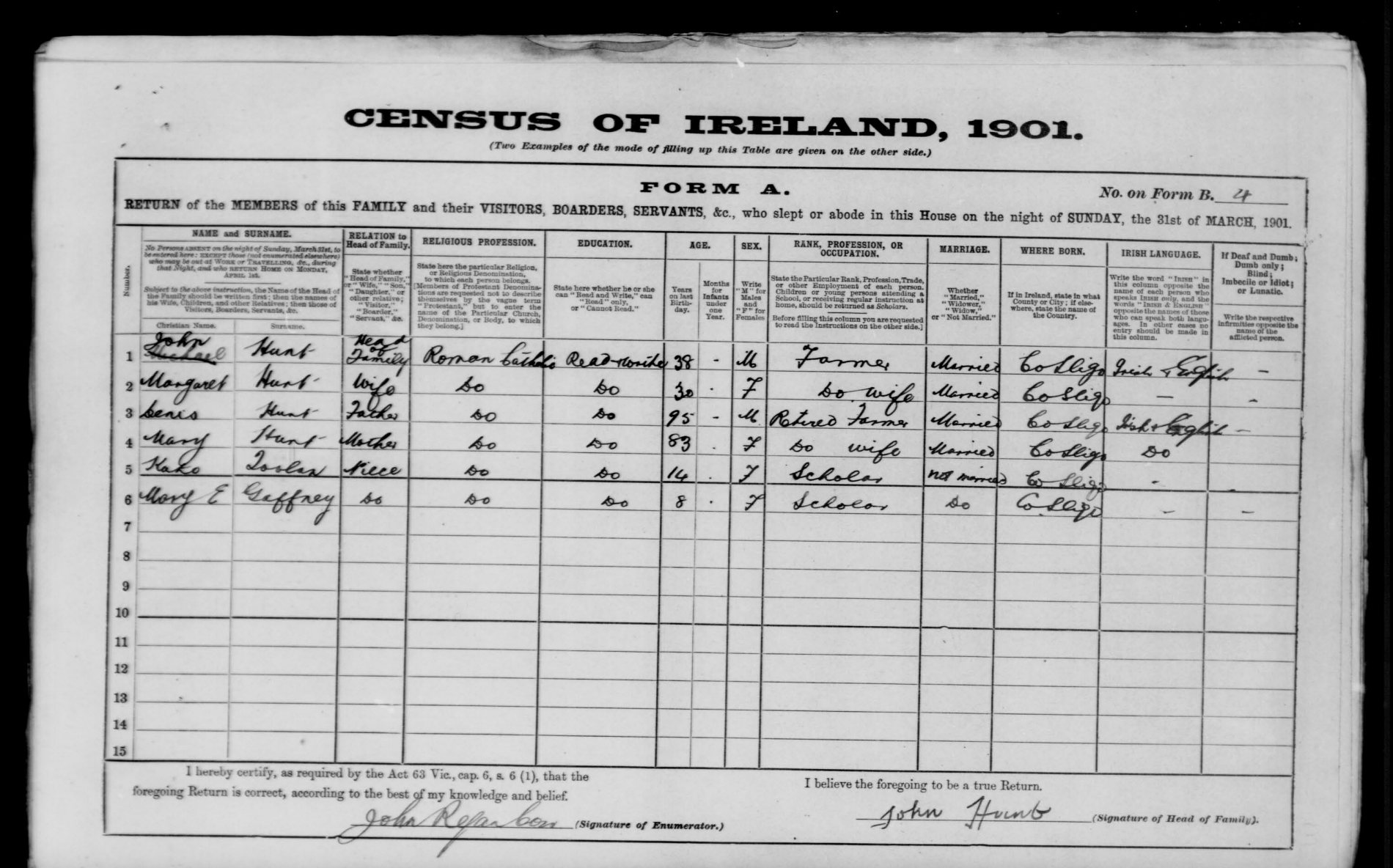
John's parents were extraordinarily old for their time. In the 1901 census, taken just a year after Maggie and John's wedding, Denis Hunt was listed at age 95 — which means he was born around 1806, during the Napoleonic Wars. His wife Mary was listed as 83 years old, born around 1818. Both were alive to see their son's marriage, and both survived the birth of their first grandchild with Maggie.
Denis had lived through Ireland's entire nineteenth century: the 1820s agricultural boom, the Tithe Wars, the Famine of 1845–1852, the Land Wars, and into the twentieth century. His longevity was remarkable. His wife Mary, born during the Peninsular War, lived nearly as long.
The 1901 Household
The 1901 census captured the Hunt household in a remarkable moment: three generations under one roof. The enumerator recorded:
- John Hunt (38 years), head of household
- Margaret Hunt (30 years), his wife — Maggie
- Denis Hunt (95 years), John's father — the patriarch
- Mary Hunt (83 years), John's mother
- Kate Doolan (14 years), niece
- Mary E. Gaffney (8 years), niece
Mary E. Gaffney, age 8, was listed as a "niece." Genealogically, she was almost certainly the daughter of John Gaffney and Margaret Scanlon — making her Maggie's niece and confirming the Gaffney family continued to live nearby and maintain close household bonds. The presence of both Mary E. and Kate Doolan suggests John and Maggie's home was a hub for extended family.
By 1911, Denis and Mary were gone. The census that year showed John, Maggie, and their four children: Mary J. (c. 1902), Pat William (c. 1907), Catherine (c. 1909), and John (c. 1910). The household of nine had become a household of six.
John Hunt — The Unlikely IRA Lieutenant
The most remarkable fact about John Hunt is what he did during the War of Independence. In 1919–1921, when he was approximately 54–56 years old, John served as a 1st Lieutenant in the Jamestown Company of the Irish Republican Army. By any measure, this was unusual: most IRA volunteers were men in their twenties and thirties. John was old enough to be the father of many of his comrades.
More significantly, his commanding officer was Captain John Joseph Gaffney of Gort, Co. Leitrim — born 1894, son of Michael Gaffney and Mary Anne Fitzsimmons. John Joseph was Maggie's relative by marriage (through her husband's connection), but the relationship ran deeper than a simple family tie. The cross-county service — from Sligo into Leitrim, under a Gaffney captain — suggests bonds forged over generations.
This was the proven connection the researchers had been seeking. Maggie's marriage to John Hunt was not merely a local farmers' wedding. It was a link in a chain that connected the Falleens Gaffneys of Sligo to the Gort Gaffneys of Leitrim through the War of Independence itself.
Maggie's Court Records

The Hunts were not a quiet family. In 1920, during the height of the War of Independence, Maggie filed complaints against her English neighbor Annie "Nannie" Reycroft for "threatening and abusive language." While John was out with the IRA — serving as 1st Lieutenant under Captain John Joseph Gaffney — Maggie was holding the line at home against a hostile neighbor. Cases appeared in both Sligo Borough Court and Ballymote Court.

The petty sessions records paint a vivid picture of life in rural Sligo during the revolution. Maggie was also fined for keeping an unregistered dog — a minor offence, but the kind of thing the authorities noticed when your husband was a wanted man.
These records, preserved in FindMyPast's Ireland Petty Sessions Court Registers, show Maggie as a woman who stood her ground. While her husband fought for Irish independence with rifles and ambushes, she fought back through the courts — a different kind of resistance, but no less determined.

Why This Marriage Matters
For weeks, researchers searched for a single paper trail connecting the Falleens Gaffneys to the Gort branch. They looked through baptism registers, examined death records, cross-checked Griffith's Valuation plots, and traced every possible surname variant. The records simply did not yield an explicit statement: "John Gaffney of Falleens and Patrick Gaffney of Cuilmore were brothers."
But Maggie's marriage was the breakthrough. Through her, we can trace a clear chain:
- Patrick Gaffney of Cuilmore (her father, farmer, d. 1888)
- → Margaret "Maggie" Gaffney (his daughter, b. 1869)
- → John Hunt of Mullaghroe (her husband, IRA Lieutenant)
- → Service under Captain John Joseph Gaffney of Gort (relative by marriage, IRA Captain)
This chain connects the Falleens sphere (through Patrick of Cuilmore, Maggie's father) to the Gort sphere (through IRA command structures) in a way that no single document could have proven. The Gaffney families were not isolated rural households. They were part of a republican network, a family diaspora, and a community that fought together.
The Bridge
Researchers spent weeks trying to find a direct paper trail between the Falleens brothers and the Gort Gaffneys. In the end, it was Maggie's marriage — and her husband's IRA service — that proved the families were connected. Sometimes the most important records aren't birth certificates or baptisms. They're the choices people make about who to marry and who to fight alongside.